
GarEx Production & Inventory Tracking
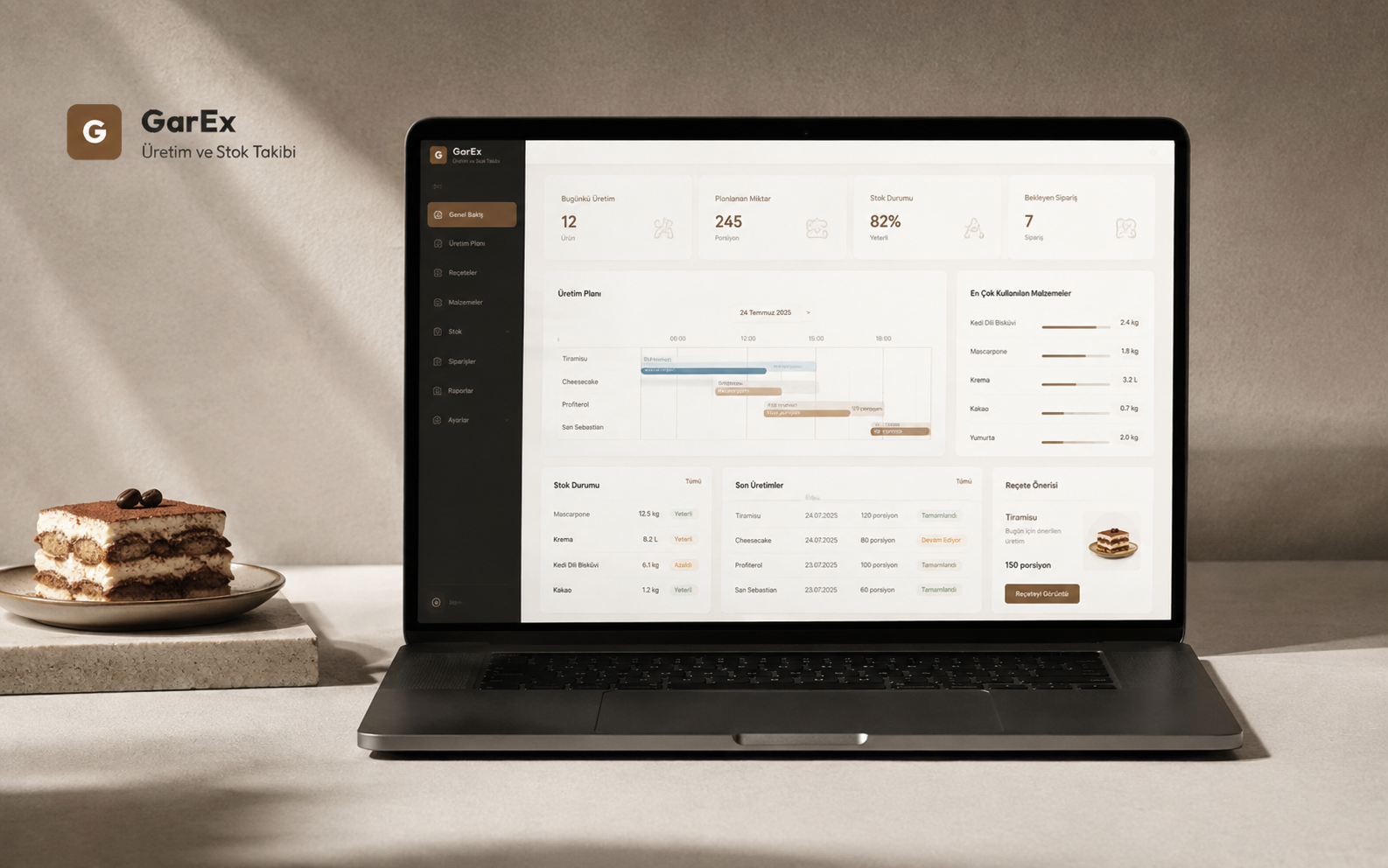
GarEx was engineered for boutique pastry workshops to monitor raw material inventories, procurement records, recipes, and production schedules within a single, local desktop environment. Featuring a focused Turkish interface, it streamlines day-to-day operations through movement-based inventory calculations, controlled production pipelines, and AI-assisted receipt drafts requiring explicit user confirmation.
GarEx was engineered for boutique pastry workshops to monitor raw material inventories, procurement records, recipes, and production schedules within a single, local desktop environment. Featuring a focused Turkish interface, it streamlines day-to-day operations through movement-based inventory calculations, controlled production pipelines, and AI-assisted receipt drafts requiring explicit user confirmation.
Context & Challenge
GarEx was developed to address the need for a boutique confectionery workshop to systematically structure its raw materials, purchasing records, recipes, and production workflows.
The project scope was established through on-site stakeholder sessions and two hours of live workflow observation. The goal was not to deploy a cumbersome enterprise ERP, but to build a lean, local operational instrument that directly empowers daily production decisions.
Local-First Desktop Architecture
The application is built within the Tauri v2 desktop shell utilizing React, TypeScript, and Vite. Data is maintained in a local SQLite database through the Tauri SQL plugin.
This framework removes the necessity for user account management, remote cloud databases, or network synchronization, providing uninterrupted single-machine performance. The complete user interface is crafted natively in Turkish.
Movement-Based Stock Control
Stock levels are never stored as static, arbitrary integers; they are calculated dynamically from the cumulative sum of intake purchases, manual balance adjustments, and production consumption.
Raw materials are defined across base units (g, ml, units, m). Standardized pre-entry unit conversions (such as kg-to-g and l-to-ml) ensure structural data consistency, while negative inventory states are strictly prevented across manual deductions and production cycles by default.
Procurement & Document Verification
The procurement module handles document metadata, line-item products, quantities, unit prices, and applicable VAT tiers. Upon approval, incoming purchases generate atomic inventory intake movements.
The receipt processing flow leverages OpenRouter to extract structured line items from document captures. AI outputs never write directly to the database; they appear as editable drafts for manual product mapping and validation. Inventory updates occur exclusively following deliberate user confirmation.
From Recipe to Execution
Recipes are bound directly to active raw material records. When drafting a production batch, recipe quantities scale against batch multipliers and are cross-referenced with real-time inventory balances.
The planning stage does not alter stock counts. Once production is executed and completed, corresponding raw material deductions are logged, and completed batches are permanently locked against duplicate runs.
Operational Impact & Feedback
Direct operational feedback from the workshop indicates that logging and planning cycles were reduced by 50%, ingredient waste was noticeably minimized, and daily operations shifted toward a structured, predictable rhythm.
This assessment represents authentic user feedback from daily production rather than a synthetic benchmark analysis.
Scope & Deliverables
- Native desktop application engineering built with Tauri v2, React, TypeScript, Vite, and Rust
- Local data architecture powered by SQLite and Tauri SQL plugin integration
- Raw material management, movement logging, unit standardization, and negative stock prevention
- Procurement draft workflow with VAT calculation and approval-driven stock intake
- AI-assisted receipt/invoice parsing via OpenRouter with editable drafts and manual review
- Recipe management, batch production planning, proportional scaling, and stock feasibility checks
- Automated inventory deduction upon production completion, operational reporting, and local backup/export
- Supplementary deliverables defined in brief: brand strategy and print collateral
Let’s start a similar project.
Let’s start a conversation to establish a solid design foundation for your brand.